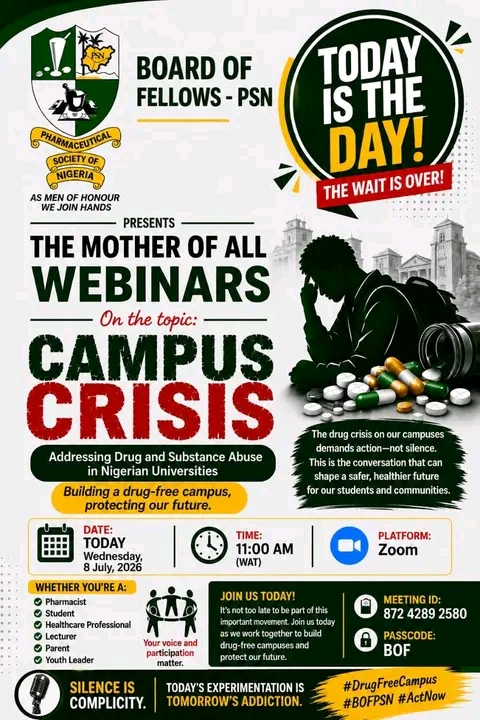
Following weeks of extensive planning and publicity, the highly anticipated webinar hosted by the Drug and Substance Abuse Committee of the Board of Fellows of the Pharmaceutical Society of Nigeria (BOF-PSN) concluded with a renewed call for stronger collaboration among stakeholders to tackle the growing challenge of drug and substance abuse in Nigerian universities.
The virtual event, hosted by the committee chaired by Pharm. (Dr.) Kingsley Chiedu Amibor, FPSN, FCPHARM, FNAPharm, brought together policymakers, regulators, academics, pharmacy professionals and student leaders from across the country to explore practical and sustainable solutions to the problem.
The webinar commenced with opening remarks by the Chairman of the PSN Board of Fellows, Pharm. Uche Akpakama, who welcomed participants and reaffirmed the Board’s commitment to addressing the growing menace of drug and substance abuse among young Nigerians.
Host of the webinar, Pharm. (Dr.) Kingsley Amibor, explained that the initiative was conceived to promote evidence-based discussions and strengthen collaborative efforts aimed at reducing substance abuse in tertiary institutions.





The session was moderated by the lead panellist, Pharm. (Dr.) Lolu Ojo, while the President of the African Society of Clinical Pharmacists, Dr. Joseph Madu, delivered the citation of the keynote speaker.
Delivering the keynote address, Prof. Oluwatoyin Odeku highlighted critical areas requiring greater attention in tackling drug and substance abuse in Nigerian universities. She stressed the need to expand academic and clinical research, strengthen leadership and innovation and increase the presence of pharmacists, particularly in community pharmacy practice, to discourage the inappropriate dispensing of medicines.
She also raised concerns about Nigeria’s drug distribution system, questioning the integrity of the pharmaceutical supply chain. Prof. Odeku called for stronger strategic partnerships between government agencies, including the National Agency for Food and Drug Administration and Control (NAFDAC) and the National Drug Law Enforcement Agency (NDLEA), to improve compliance, surveillance and enforcement.
According to her, drug abuse reflects a broader social crisis affecting young people, families and communities and therefore requires a comprehensive, multi-sectoral response rather than isolated interventions.
Speaking during the panel discussion, Prof. Mohammed Garba Magaji of Ahmadu Bello University noted that many universities are increasingly adopting preventive and rehabilitative measures instead of relying solely on punitive approaches. He advocated the establishment of Drug and Substance Abuse Counselling Committees in every university, domiciled within the Office of the Vice-Chancellor, to coordinate prevention, counselling and rehabilitation programmes.
Also contributing to the discussion, Prof. Michael Ubaka, former Commissioner for Secondary and Tertiary Healthcare in Imo State, stressed that government alone cannot effectively tackle drug abuse. He called for sustained public awareness campaigns, active surveillance and continuous monitoring involving all relevant stakeholders.
Student leaders also underscored the importance of parental guidance, moral upbringing and greater student participation in anti-drug campaigns. They identified peer pressure and the influence of social media as major drivers of substance abuse among undergraduates and urged universities to actively involve students in developing and implementing preventive strategies.
Responding to questions from the moderator, the National President of the Pharmaceutical Association of Nigerian Students (PANS) observed that knowledge of drugs does not necessarily prevent substance abuse. He noted that even pharmacy students, despite their professional training, sometimes misuse drugs, particularly during examination periods, highlighting the complexity of the challenge.
Dignitaries who attended the webinar included the Director-General of the National Agency for Food and Drug Administration and Control (NAFDAC), Prof. Mojisola Adeyeye; keynote speaker and former Dean of the Faculty of Pharmacy, University of Ibadan, Prof. Oluwatoyin Odeku; Prof. Michael Ubaka; Prof. Mohammed Garba Magaji; lead panellist Pharm. (Dr.) Lolu Ojo; Chairman of the PSN Board of Fellows and Chief Host, Pharm. Uche Akpakama, FPSN; Vice Chairman of the Board, Dr. Rametu Momodu; representatives of the Pharmaceutical Association of Nigerian Students (PANS); and the Students’ Union Government (SUG) President of Obafemi Awolowo University, Adelani David Oluwatodimu, among others.
Participants unanimously called for stronger policies, improved counselling services and enhanced collaboration among regulatory agencies, educational institutions, families, healthcare professionals and student bodies to effectively tackle the menace.
The webinar concluded with a renewed commitment to building a drug-free society through sustained advocacy, education, strategic partnerships and collective action.
Speakers also referenced global statistics from the World Health Organization (WHO), noting that approximately 64 million people worldwide—about one in every 81 individuals—live with drug-related disorders, underscoring the urgent need for coordinated efforts to address the growing public health challenge.