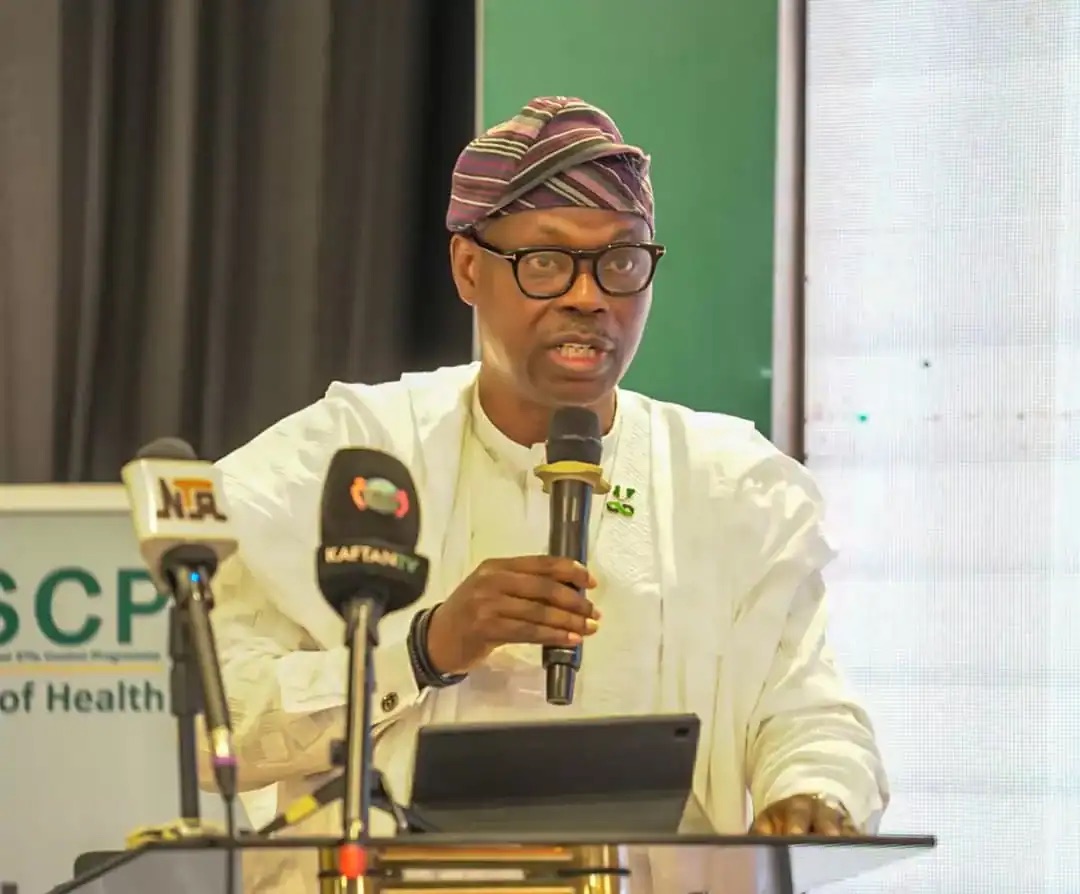
The Federal Government has begun working with telecommunications companies to accelerate the expansion of digital health services across Nigeria, with a focus on improving access to healthcare in underserved communities.
The initiative was disclosed by the Minister of State for Health, Dr Adekunle Salako, during the 6th Africa Digital Health Summit in Abuja, where he said the government is partnering with telecom operators to strengthen the country’s digital health infrastructure.
As part of the collaboration, telecommunications firms, including Airtel, ipNX, NIGCOMSAT, INQ Digital and other industry stakeholders, have agreed to provide geo-coordinates of telecom infrastructure, fibre optic cable information and capability assessments to support the rollout of digital health initiatives nationwide.
Salako said the Federal Government is also strengthening the legal framework for the sector through the proposed Digital Health Services Bill. According to him, the legislation, which had its first reading at the House of Representatives in March 2025, seeks to establish a comprehensive regulatory framework for digital health services, including mandatory licensing of providers and interoperability standards.






He called on the National Assembly to expedite consideration of the bill and other legislative measures needed to support the government’s plan to make digitalisation a key part of healthcare delivery.
The minister, however, identified infrastructure and workforce shortages as major obstacles to the country’s digital health ambitions. He said an assessment of Nigeria’s health information and communication technology workforce revealed inadequate ICT knowledge among many healthcare workers, with deficiencies exceeding 50 per cent in several knowledge areas and significant disparities between urban and rural areas.
He stressed the need to build a skilled workforce capable of developing, implementing and maintaining digital health systems, noting that, “technology is only as strong as the people who use it.”
Salako also raised concerns over inadequate infrastructure, revealing that about 43 per cent of Primary Healthcare Centres (PHCs) across the country have no electricity, while many of those connected to the grid receive only about five hours of power daily.
He added that nearly 60 per cent of rural communities remain without internet connectivity, warning that digital health services cannot effectively reach vulnerable populations without reliable electricity and broadband access.
“We have made progress through initiatives like the rural electrification projects now being institutionalised through the Nigeria Power for Health Initiative and the Nigeria Broadband Plan, but the gap remains substantial,” he said.
“Connectivity must be treated as a fundamental right for healthcare delivery, not a luxury.”
The minister also stressed the need for interoperability across digital health platforms, warning that disconnected systems reduce the effectiveness of healthcare delivery.
“Without interoperability, digital health solutions remain islands of excellence in a sea of fragmentation,” he said, adding that a national health information exchange supported by a terminology server would help ensure coordinated, meaningful and non-duplicated health data.
Salako described digital health as an essential tool for achieving Universal Health Coverage, adding that the Nigeria Data Protection Act 2023 now classifies healthcare stakeholders as data controllers of major importance, requiring strict compliance with data protection regulations.
He disclosed that the National Primary Healthcare Development Agency (NPHCDA), the Federal Government and the Association of Local Governments of Nigeria had agreed to digitise 20 per cent of primary healthcare centres annually from 2026.
According to him, the NPHCDA is developing a unified Electronic Community Health Information System for community health workers, while the HOPE Primary Healthcare Programme has committed $525 million to strengthening primary healthcare, with digital health forming a key component of the investment.
Salako explained that funding under the programme is tied to performance indicators that encourage states to adopt the National Digital Health Architecture and integrate critical healthcare functions.
The minister also expressed concern over the existence of multiple health information systems operated by different programmes and development partners, saying many of them function independently without sharing data.
He identified the National Data Repository, LAMISPlus, VIVA EMR, NigeriaMRS and DHIS2 registers as examples of platforms using different patient identifiers and facility lists.
According to him, the lack of integration disrupts continuity of care, leads to duplication of efforts and weakens evidence-based decision-making.
“Without a unified approach, we cannot achieve the vision of one patient, one health record,” he said.
Salako further noted that Nigeria’s digital health ecosystem has relied heavily on donor funding, with many projects failing to progress beyond pilot stages.
He said existing funding sources, including the HOPE PHC Programme and the Basic Healthcare Provision Fund, remain inadequate for nationwide digitisation, stressing the need for innovative financing models and stronger public-private partnerships.