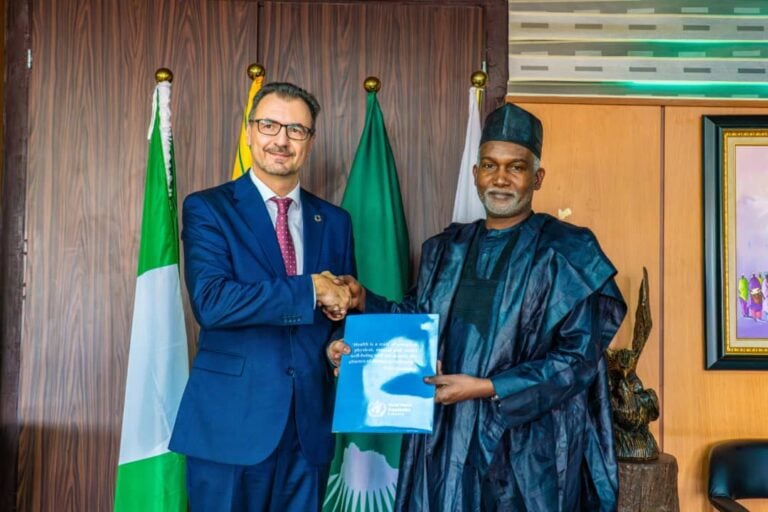
The World Health Organization (WHO) has officially named Dr Pavel Ursu as its new Representative to Nigeria.
This appointment follows the formal presentation of Ursu’s credentials to the Federal Ministry of Foreign Affairs in Abuja, a development confirmed by a press statement released by the UN agency on Tuesday.
Dr Ursu succeeds Dr Kazadi Mulombo, who now holds the position of Director, Office of the Regional Director, WHO African Region, and is Acting WHO Representative to Guinea-Bissau. Mulombo served as WHO’s Country Representative to Nigeria for five years, providing notable leadership in advancing key public health initiatives.
Prior to Dr Ursu’s appointment, Dr Alex Gasasira acted as WHO Representative ad interim in Nigeria, ensuring the continuity of the organization’s operations and engagement with national stakeholders.
Speaking on the appointment, the Minister of Foreign Affairs, Yusuf Tuggar, welcomed Dr Ursu to the country and expressed optimism about strengthening collaboration with WHO under his leadership.
“We welcome Dr Ursu to Nigeria and look forward to deepening our collaboration with WHO under his leadership,” Tuggar said.
He noted that the COVID-19 pandemic highlighted vulnerabilities in Nigeria’s health system, particularly around vaccine operations, and stressed the government’s commitment to boosting local health product manufacturing.
“Health is not just a sector; it is a foundation for prosperity. A healthy population is empowered to seek opportunities and rise out of poverty,” Tuggar added.
He further emphasised that this focus aligns with both pillars of the Ministry’s mandate—national development and international diplomacy—and underlined Universal Health Coverage (UHC) as a key component of Nigeria’s health agenda.
In his remarks, Dr Ursu expressed WHO’s deep respect for Nigeria’s leadership in global health and highlighted some of the country’s notable accomplishments, including the eradication of wild poliovirus and a recent immunization campaign that reached over 106 million children.
Dr Ursu also highlighted Nigeria’s strategic importance, noting that WHO’s largest country office in Africa is located in the country. He outlined six core areas for enhanced cooperation between WHO and the Federal Government: domestic health financing; Primary Health Care and UHC; emergency preparedness and health security; data and digital transformation; local manufacturing and innovation; and health diplomacy and multisectoral engagement.
“Nigeria’s strength lies in its people, innovation, and resolve to reform. WHO will focus on ensuring our cooperation translates into measurable improvements in people’s lives,” he said.
Dr Ursu brings over 20 years of experience with WHO, covering national and international assignments. He holds dual citizenship of Romania/EU and Moldova. Since May 2020, he has served as Director of the Department of Delivery for Impact at WHO Headquarters in Geneva, leading initiatives to strengthen health systems and promote sustainable development.
His previous WHO roles include Country Representative in Tajikistan (2010–2015), WHO Representative in Türkiye (2015–2020)—where he received the WHO Director-General’s Award for his leadership during the Syrian refugee crisis—Acting WHO Representative in Azerbaijan and Kazakhstan, and Head of the WHO Country Office in Moldova.
Dr Ursu is a medical doctor with a Master of Science and a Postgraduate Diploma in Public Health from the London School of Hygiene and Tropical Medicine, a Master’s in Health Services Management, and a Diploma in High Impact Leadership from the University of Cambridge.
“I am honoured to serve as WHO Representative to Nigeria and look forward to working closely with national authorities, development partners, and communities to advance health for all,” Dr Ursu said.