By: Oyewole O. Sarumi PhD
The recent Association of Industrial Pharmacists of Nigeria (NAIP) Economic Outlook and CEOs Forum in Lagos marked a defining moment in Nigeria’s pharmaceutical narrative, one that seeks to pivot the country from chronic importation and passive reliance to self-reliance through proactive industrial strategy and visionary leadership. In the presence of traditional rulers, industry leaders, regulators, and policy architects, the gathering crystallised a powerful consensus: Nigeria’s health security demands local production, and that local production must be deep, sustainable, and globally competitive. Despite the rhetoric and high-profile support, however, Nigeria remains entangled in a systemic dependence on imported finished drugs, APIs, and excipients.
With the dignified presence of His Royal Majesty Igwe Nnaemeka Alfred Achebe, the Obi of Onitsha, and the intellectual force of Mallam Muhammadu Sanusi II, the Emir of Kano, and the sight of industry captains like Dr. Okey Akpa, Dr. Ifeanyi Okoye, and Pharm. Ahmed Babashehu, uniting for “Health Security” is encouraging. However, as I reviewed the reports of this “solutions-focused platform,” a familiar sense of déjà vu washed over me. We have been here before.
The National Drug Policy of 2005 set a similar target: to utilize 70 percent of local capacity and satisfy 60 percent of national drug requirements by 2008. That deadline passed eighteen years ago, and today, we remain stuck at a meager 30 percent local production, while a staggering 70-80 percent of our medicines are still imported. We are, in essence, running on a treadmill, expending energy and generating heat, but moving nowhere.
The time for “talk shops” is over. If Nigeria is to avoid repeating this cycle of unfulfilled promises, we must look beyond the pageantry of conferences and dissect the brutal realities of our supply chain. We must ask the hard questions: Why are we still importing 100 percent of our Active Pharmaceutical Ingredients (APIs)? Why are our research institutes failing to commercialize their findings? And most importantly, what did India and China do that we are refusing to do?
This essay examines the current realities, contrasts global best-practice models, particularly India and China, and offers a strategic framework that could enable Nigeria to achieve 80% local production and emerge as an African pharmaceutical hub by 2036.
The Current Ecosystem: Promise Versus Reality
Nigeria’s pharmaceutical sector sits at a paradoxical intersection. On one hand, the domestic market is large and growing, with projections suggesting a value exceeding N3 trillion to N5 trillion in the coming years driven by healthcare demand and population growth. On the other hand, local industrial capacity, particularly in Active Pharmaceutical Ingredient (API) production, remains nominal. Estimates indicate that Nigeria currently produces only about 20–30% of its pharmaceutical needs locally, with approximately 70% of medicines and APIs imported predominantly from India and China, a situation the Emir of Kano aptly described at the Forum as a “significant threat to national security.”
By relying on imported APIs and excipients, the Nigerian pharmaceutical industry effectively imports the inflation, exchange rate volatility, and supply chain shocks of foreign nations. When the Naira fluctuates against the Dollar, the cost of the raw powder needed to make paracetamol or antimalarials spikes overnight. We are building our house on the shifting sands of the foreign exchange market.
The reliance on imports is not merely a trade statistic; it has deep economic and health implications. Nigeria reportedly spends over N1 trillion annually on API imports alone, representing a considerable drain on foreign exchange reserves, exacerbated by the volatility of currency markets and scarcity of forex liquidity. The knock-on effects include high medicine costs, supply volatility, and vulnerability to external shocks, as vividly demonstrated during the COVID-19 pandemic when global supply chains were disrupted.
The recent forum touched on this, with NAIP Chairman Pharm. Bankole Ezebuilo calling for “patient capital.” But capital alone is insufficient without a structural shift. We cannot claim “Health Security” when the very molecules that cure our citizens are synthesized in factories in Gujarat or Jiangsu, subject to the whims of foreign export bans (as we saw during COVID-19).
Indeed, our local manufacturers face multifaceted challenges: outdated machinery, high cost of energy, inadequate quality assurance systems, high costs of compliance with Good Manufacturing Practices (GMP), and weak infrastructural support. Nearly 98% of raw materials (APIs and excipients) are imported, leaving manufacturers exposed to forex volatility and supply disruptions that stifle growth and competitiveness. The regulatory environment, while evolving, has yet to provide the robust incentives and streamlined processes that could galvanise industrial expansion and investor confidence like done in Global space.
Against this backdrop, NAIP’s call for a strategic reset, one rooted in innovation, partnerships, and ethical leadership, is timely. Yet the aspirations articulated must be coupled with concrete policy, substantial financing, and structural transformation that goes beyond rhetoric and short-term workshops.
Lessons from India and China: Insights for Nigeria
To chart a credible path forward, Nigeria must critically analyse the experiences of India and China, two nations that have ascended to dominant positions in global pharmaceutical manufacturing.
China: Scale and Chemical Supremacy
China’s rise to become the global powerhouse in the production of commodity APIs is rooted in its expansive chemical manufacturing infrastructure, economies of scale, and cost competitiveness. As of 2025, China controlled an estimated 60–80% of the global supply of APIs and key starting materials (KSMs), with annual production capacity exceeding two million tons and over 2,000 API molecules under manufacture. This dominance stems from strategic government support, infrastructure investment in chemical parks, tax incentives, and a labour cost structure significantly lower than Western competitors.
Let me explain the above in simple terms. China took a different, more industrial route. Their strategy was vertical integration. A Chinese pharmaceutical park doesn’t just make the final drug; it makes the basic chemicals, the solvents, the intermediates, and the APIs all in one ecosystem. This drastically reduces logistics costs and “friend-shores” the supply chain within their own borders.
Moreover, China focused on massive scale. While a standard fermenter in the West might hold 20,000 liters, Chinese factories installed 200,000-liter tanks. This economy of scale allowed them to drop prices so low that competitors globally, including in the West, could not compete, forcing them to shut down and effectively handing the global monopoly on penicillin and vitamin C to China.
However, China’s model also illustrates some limitations: regulatory quality challenges and increasing focus on environmental sustainability are shaping a gradual shift toward higher-value intermediates, biologics, and green chemistry.
India pursued Quality, Compliance, and Policy-Led Growth
While China’s strength has traditionally been in bulk commodity chemicals, India’s pharmaceutical ascent has been propelled by a deliberate drive toward regulatory quality and integration with global markets. In the 1970s, India was in a position not unlike Nigeria today. Their pivotal move was the Patents Act of 1970. Unlike the West, which protected the product, India chose to protect only the process. This allowed Indian companies to legally reverse-engineer patented drugs, provided they used a different manufacturing process. This unleashed a wave of innovation and cost-reduction that birthed giants like Sun Pharma and Dr. Reddy’s.
Today, Indian companies operate over 600 US FDA-approved facilities, the highest number outside the United States, and hold widespread certifications from EMA and WHO, underpinning global confidence in Indian APIs and finished products. India supplies approximately 20% of global API output and about 50% of the generic drugs used in developed markets such as the US and Europe.
Like I opined above, a pivotal factor in India’s success has been targeted government interventions, notably the Production-Linked Incentive (PLI) Scheme for APIs. This policy provides financial incentives tied to performance, encourages backward integration, and supports the development of bulk drug parks with shared utilities and R&D infrastructure, effectively reducing entry barriers and encouraging scale. In other words, the Indian government didn’t just ask for growth; they incentivized it through Production Linked Incentive (PLI) schemes, offering financial rewards to companies that manufactured key starting materials (KSMs) and APIs domestically. They focused on generics, the bread and butter of global health, and mastered the art of low-cost, high-volume production.
These strategic incentives have helped India move beyond merely importing intermediates to becoming a centre of pharmaceutical innovation and production.
Critically, India’s model is not solely about low cost. It combines regulatory compliance, quality assurance, investment in R&D, and workforce development, elements that have enabled Indian firms to compete in heavily regulated Western markets and diversify their product portfolios across therapeutic segments.
The Nigerian Reality: Research Disconnect and The Way Forward
When we contrast the Asian aggressive industrial policy with our current state, the gap is obvious, but not impossible to bridge. We have research institutes like the National Institute for Pharmaceutical Research and Development (NIPRD) and the Institute for Drug-Herbal Medicine-Excipient Research and Development at UNN. There is even another one in the Faculty of Pharmacy, at OAU. While reports indicate NIPRD has engaged in over 100 collaborations and is working on WHO pre-qualification support, the translation of these efforts into commercial products remains agonizingly slow.
Our research institutes are often treated as academic ivory towers rather than industrial engines. This should cease and they must be “rejigged” to contribute to the aspirations that emanates from this NAIP gathering. We do not need more papers published in journals; we need patents filed and licensed to local manufacturers. We need a mandate that challenges these institutes to develop locally potent APIs from our abundant petrochemical and agricultural resources. If we have cassava, why are we importing pharmaceutical-grade starch? If we have petrochemical refineries (Dangote, etc.), why are we importing the solvents needed for drug synthesis?
There are sparks of hope. The Emzor Pharmaceutical API plant in Sagamu, a reported multimillion-dollar investment, is a monumental step in the right direction. It proves that local API production is possible. But one swallow does not make a summer as the saying goes. We need ten, twenty of such plants, backed by government guarantees to purchase their output for national hospitals that liters the country.
Strategic Imperatives for Nigeria
When drawing from global best practices, Nigeria’s pharmaceutical transformation agenda must revolve around several interrelated pillars.
First, Nigeria must prioritise the development of local API production. This requires a shift from the traditional formulation-centric model to one that embraces chemical synthesis, process engineering, and downstream pharmaceutical chemistry. Projects such as the nascent API plant by Emzor Pharmaceuticals, backed by European Investment Bank funding, exemplify early steps toward this transition, with targeted production of APIs sufficient for millions of doses of essential medicines. However, beyond isolated projects, what is required is a national API ecosystem, facilities that are financially viable, technologically sophisticated, and integrated with local manufacturing clusters.
To achieve scale, the government must introduce targeted incentives akin to India’s PLI scheme: tax credits for high-value API segments, funding for bulk drug parks with shared utilities, and long-term financing instruments that lower capital costs. Nigeria must also invest in backward integration, encouraging the local production of KSMs and intermediates. This vertical integration will reduce input dependence on external markets and shield manufacturers from forex volatility.
Second, regulatory reform is essential. Our regulatory bodies such as NAFDAC and the Pharmacy Council of Nigeria must work with industry and academia to streamline certification processes, ensure consistent application of GMP standards, and provide clear, stable policies that reduce compliance uncertainty. International accreditation (WHO-GMP, US FDA equivalence) should become a national priority, opening export pathways and integrating Nigeria into global supply chains.
Third, our research institutes and universities must be repositioned as active partners in pharmaceutical innovation. Currently, research outputs rarely translate into commercial impact. Nigeria should incentivise collaboration between academia and industry, establish translational research grants, and encourage joint ventures with global pharmaceutical entities. Centres of excellence focused on medicinal chemistry, biotechnology, and pharmaceutical manufacturing should be funded and linked to industry pipelines. International partnerships with institutions in India, China, and Western countries can accelerate technology transfer and capacity building.
Fourth, the private sector must be mobilised as a strategic driver of industrial transformation. Encouraging entrepreneurship within the pharmaceutical value chain, from formulation to contract research, clinical services, and biotech, will stimulate a diversified ecosystem. Contract Development and Manufacturing Organisations (CDMOs), which have been central to India’s global integration, could be incubated in Nigeria, leveraging AI and advanced analytics to build competitive capability in API synthesis and high-value therapeutic areas.
Fifth, infrastructure and logistics must be strengthened. Reliable energy, efficient transportation networks, and integrated supply chain systems are non-negotiable foundations for industrial growth. Public-private partnerships should be leveraged to modernise utilities and logistics, reducing production costs and improving competitiveness.
Nigeria’s Opportunity in the AI and Digital Era
In the age of AI and digital transformation, Nigeria’s pharmaceutical industry can leapfrog traditional models by adopting technologies that enhance process efficiency, accelerate R&D, and improve quality assurance. AI-driven drug discovery platforms can shorten development cycles, while digital twins and predictive analytics can optimise manufacturing processes, reducing waste and enhancing compliance. These technologies, when coupled with high-quality data and regulatory frameworks, can create a new competitive frontier for Nigeria’s pharma sector.
Furthermore, blockchain-enabled supply chain tracking can improve traceability, combat counterfeit medicines, and build trust in Nigerian products domestically and internationally. Digital health platforms can also expand access to medicines, integrate with national health systems, and provide real-time market intelligence for manufacturers.
Vision 2036: A Pan-African Pharmaceutical Hub
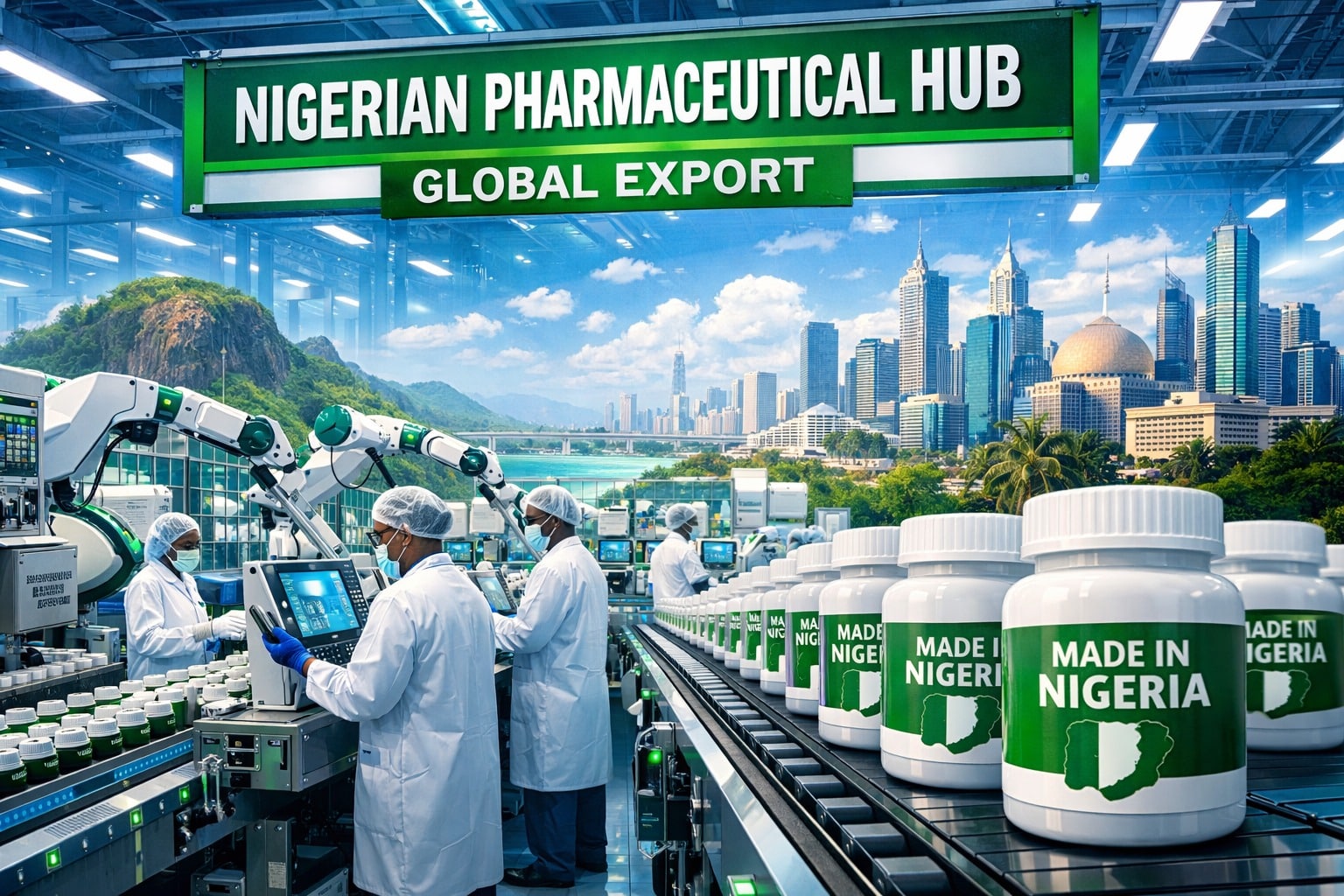
If Nigeria commits to this strategic framework with disciplined implementation over the next decade, it can realistically transform its pharmaceutical sector from import dependence to industrial leadership. By 2036, Nigeria could command a pharmaceutical production capacity of 70–80% of domestic demand, with surplus export capability to neighbouring West African markets and beyond. This would position Nigeria as a Pan-African pharmaceutical hub, creating jobs, enhancing health security, and generating foreign exchange through exports.
Realising this vision requires political will, strategic investment, and collaborative execution across government, industry, academia, and civil society. The NAIP Forum’s declarations highlight the urgency, but declarations must give way to action plans, measurable milestones, and accountability frameworks.
Conclusion
Nigeria’s pharmaceutical potential is vast, but unlocking it demands a bold, structured, and sustained industrial strategy. Lessons from India and China illuminate the importance of regulatory excellence, targeted incentives, research integration, and quality assurance. By embracing these principles and investing in local API production, regulatory reform, research partnerships, and digital innovation, Nigeria can transcend its historical constraints and build a resilient, self-reliant pharmaceutical industry. Such a transformation will not only achieve the 2030 production target but enable Nigeria to lead Africa’s pharmaceutical renaissance, securing both health and economic prosperity for generations to come.
Prof. Sarumi, a Pharmacist, is an international Consultant with over 40 years of experience advising CEOs, governments and corporations across Europe, Asia, and Africa on digital transformation, supply chain sovereignty, and strategic policy.