Pharmaceutical industry stakeholders have called on the Federal Government to place greater emphasis on pharmaceutical innovation, technology integration, and domestic production of essential drug ingredients as key drivers of national development and health security.
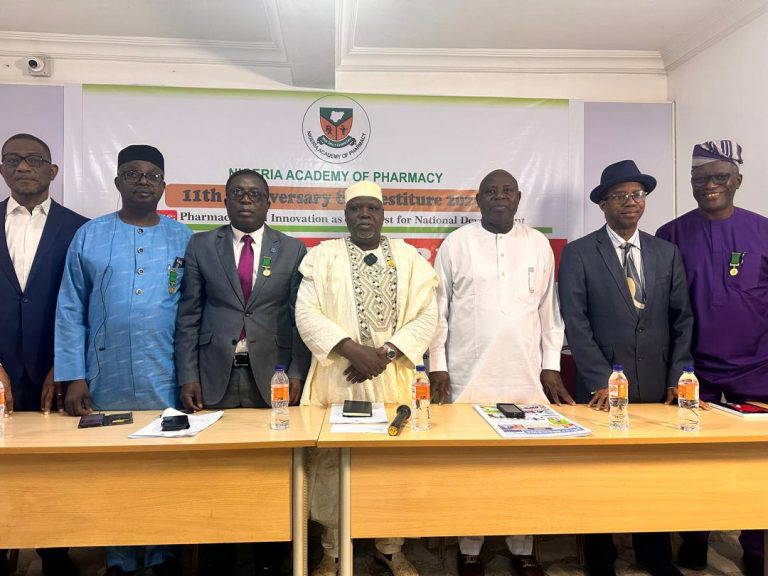
The appeal was made in the build-up to the 2025 Annual General Meeting (AGM), Valedictory Session, and Investiture of Fellows of the Nigeria Academy of Pharmacy (NAPHARM), slated for October 15–16. The leaders stressed that innovation remains the cornerstone of national progress and the foundation of the future of healthcare delivery.
During a pre-event press conference, Pharm. (Dr.) Ahmed Yakassai, Vice President 2 of NAPHARM and former President of the Pharmaceutical Society of Nigeria (PSN), emphasized that innovation has become indispensable for the pharmacy profession and for Nigeria’s survival within the global health economy.
He said:
“Without innovation, technology, and creativity, you’ll be left behind. COVID-19 showed us that without pharmaceutical innovation, a nation can be crippled. During the pandemic, countries that could not produce their own medicines suffered the most.”
Yakassai explained that NAPHARM has consistently championed advocacy, mentorship, and institutional reforms aimed at fostering innovation and reinforcing the role of pharmacists in healthcare delivery.
“Pharmacy is not a local profession; it’s a global one,” he said. “In the next two years, if we don’t embrace innovation and technology, we will be completely left behind. From drug distribution to combating falsified medicines, innovation is key.”
He further announced NAPHARM’s plan to establish the NAPHARM Research and Innovation Centre — a forward-looking institution dedicated to advancing indigenous pharmaceutical research, innovation, and policy development.
“As Nigeria pursues self-reliance in healthcare and a diversified, knowledge-driven economy, the pharmaceutical profession must stand at the heart of that transformation,” he said.
Highlighting the Academy’s milestones, Yakassai noted that NAPHARM has intensified efforts to advocate for better remuneration, defined career structures, and stronger integration of pharmacists into primary healthcare systems.
He also paid tribute to the late Pharm. (Chief) Oludolapo Ibukun Akinkugbe, one of the founding figures of pharmacy in Nigeria, whose valedictory session will be a key feature of this year’s AGM.
Pharm. Lolo Ojo, Director of Programmes at NAPHARM, reiterated that pharmaceutical innovation is essential for Nigeria’s economic revival and employment generation.
“The pharmaceutical industry can be a major driver of GDP growth,” Ojo said. “One global company alone had a turnover of $59 billion last year — more than Nigeria’s national budget. Imagine what our economy could gain if we invested strategically in local production and research.”
The stakeholders further urged the government to make urgent investments in local Active Pharmaceutical Ingredient (API) production to reduce dependence on imports.
“We have crude oil, yet we still import raw materials to make drugs,” Yakassai said. “If we can establish local API production through petrochemical industries, we can achieve true medicine security.”
Former GSK Managing Director, Pharm. Lekan Asuni, also called for stronger collaboration between regulators, academic institutions, and the media to enhance pharmacovigilance and address antimicrobial resistance.
“Healthcare without medicine is nothing,” Yakassai added. “Innovation is not optional. If we fail to invest in technology and research now, we will continue to depend on other nations for our health and our future.”
According to the Academy, the two-day event will include the induction of 14 new Fellows, presentation of four Lifetime Achievement Awards, and recognition of six Honorary Fellows. The event will also be streamed globally via PharmaStreamTV on YouTube and Zoom.
Yakassai concluded: “Together, we must build a pharmacy profession that heals, leads, and transforms. Pharmaceutical innovation is the bridge between health, science, and national development and Nigeria must not be left behind.”