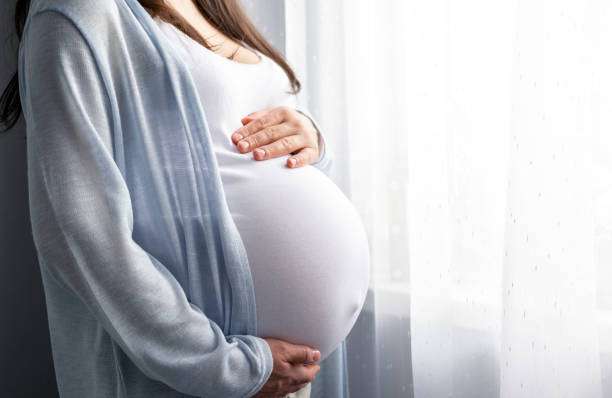
healthy pregnancy. Side view pregnant woman with big belly advanced pregnancy in hands. Banner copyspace for text. Elegant mother waiting baby
Popular health commentator, Dr Michael Ajidahun, also known as The Bearded Dr Sina on X, has highlighted that men can sometimes experience symptoms similar to those of their pregnant partners, bringing attention to the relatively unknown condition called Couvade Syndrome.
His commentary comes amid recent discussions about the emotional and psychological experiences of men during pregnancy and the postpartum period.
In a post on X on Tuesday, Dr Ajidahun wrote, “A woman can get pregnant & her husband too starts having pregnancy symptoms like her.
‘’Husband can start feeling like vomiting, gaining weight, and having mood swings. In severe cases, the man can develop labour pains & tiredness. It is rare. It is called COUVADE SYNDROME.”
While the post drew surprise and amusement from many social media users, medical experts confirm that Couvade Syndrome is a recognized psychosomatic condition in which expectant fathers develop symptoms mirroring pregnancy due to emotional or hormonal changes.
Dr Catherine Caponero, an OB/GYN at Cleveland Clinic, explained in a May 2024 article titled “Is Couvade Syndrome Real?”:
“We think couvade syndrome is a psychological response that produces real physical symptoms. Interestingly, it’s not the only example of how having a baby affects nonpregnant partners. Postpartum depression in nonbirthing partners is also common.”
A 2025 study published in Ginekologia Polska noted, “The symptoms of couvade syndrome experienced by men, such as weight gain, nausea, and changes in appetite, are noticed to a certain degree by healthcare professionals, indicating these symptoms have physiological and psychological dimensions that merit attention.”
Similarly, a 2025 article in SAGE Journals described it as, “A psychosomatic condition where expectant fathers physically manifest symptoms of pregnancy due to emotional and hormonal changes.”
Dr Ajidahun’s post also sparked renewed discussion following a viral video earlier in October, in which a man shared that he felt emotionally overlooked after his wife gave birth. The clip intensified broader conversations about the importance of recognizing men’s emotional health during and after pregnancy.
Life coach Solomon Buchi also weighed in through a video, acknowledging the challenges women face during pregnancy. Drawing from his own experience as a husband, he emphasised that men too endure emotional and physical strain during this period and deserve recognition.
“Yes, the woman is the one carrying the child, but it is the man being strong for that family at that moment… Men are not robots; they should also be spoken to in a manner that acknowledges that they are a part of the journey.”
Medical professionals note that although Couvade Syndrome is uncommon and not formally classified as a medical disorder, it is recognized as a genuine psychosomatic condition, influenced by anxiety, hormonal changes, and empathy toward a partner’s pregnancy. Research indicates its prevalence varies widely—from 11% to as high as 97%—depending on cultural and psychological factors.
As Dr. Ajidahun’s post continues to gain traction, it highlights an often-overlooked truth: while pregnancy is physically experienced by women, it can also bring emotional and physiological effects for men.