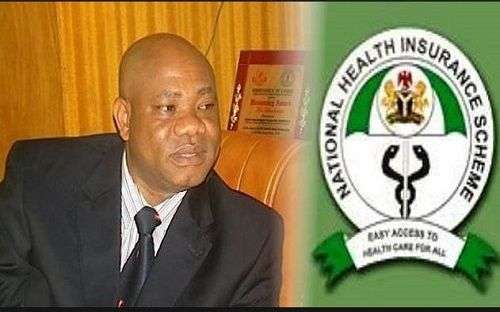
The Federal High Court in Ikoyi, Lagos, on Thursday convicted former Executive Secretary of the National Health Insurance Scheme (NHIS), Dr. Olufemi Thomas, for violating Nigeria’s cash transaction limits — but cleared him of all money laundering charges brought by the Economic and Financial Crimes Commission (EFCC).
Justice Olayinka Faji, who presided over the case, found Thomas guilty on one count relating to the making of a cash payment that exceeded the ₦5 million legal threshold — a breach of the Money Laundering (Prohibition) Act.
However, the court acquitted him on five other counts, ruling that the prosecution failed to establish its case beyond reasonable doubt.
“While the money was not proven to be proceeds of unlawful activity, the act of paying above the cash threshold is a violation,” the judge stated in a verdict that spanned several hours.
Rather than a custodial sentence, the court imposed a ₦10 million fine on Thomas in lieu of imprisonment. Additionally, Justice Faji ordered the EFCC to return all previously seized funds to the defendant within 14 days — pending full payment of the fine. Thomas is also barred from travelling outside Nigeria until the penalty is settled.
The verdict marks a significant moment in the protracted case, first initiated in June 2017, when Thomas and a second defendant, Kabiru Sidi, were arraigned on an amended seven-count charge that included conspiracy, money laundering, unlawful enrichment, and making false statements regarding a cash movement of $2.2 million.
Kabiru Sidi, a co-accused, was convicted on the lone count against him — for falsely claiming ownership of $2.1 million during EFCC investigations. He had told investigators the cash belonged to him, a claim the court found to be untrue.
In his judgment, Justice Faji took aim at the EFCC’s investigative process, noting that key claims made by the defendants were left unverified.
The court observed that while the EFCC alleged the funds were illicit, it did not substantiate claims of unlawful enrichment.
“The prosecution admitted under cross-examination that it had not fully investigated the defendant’s claims regarding the origin of the funds,” the judge noted, citing Thomas’s claim that the funds were from his farming business, supported by his financial statements.
In a statement issued after the ruling, EFCC spokesperson Dele Oyewale confirmed the Commission’s dissatisfaction with the judgment and signaled its intention to appeal the acquittal on the money laundering counts.
Prosecution counsel, Senior Advocate of Nigeria Ekele Iheanacho, had argued in his final submission that the law places a duty on defendants in such cases to explain the legitimate origin of large cash holdings.
He insisted that Thomas failed to meet this burden and urged the court to convict on all counts.
“This is a classic case of money laundering, where concealment and bypassing the financial system is central,” Iheanacho said. “The law exists to ensure that large transactions are transparent and traceable.”
However, the court found this argument insufficient, concluding that while Thomas did breach the cash transaction limit, the funds themselves were not proven to be illegal in origin.