To succeed as clinical pharmacists, the practitioners are trained to be able to think clinically in terms of what is best for the patient.
They must must be able to also understand the most important factors that affect a patient and disease state, to be able to assist both the patient and the team of healthcare providers.
It is important to emphasize that the goal for clinical pharmacists involvement in patient care is a broader and optimal approach or comprehensive medication management ( CMM ).
The patient is an active participant in the development of a CMM plan , along with other members of the care team.
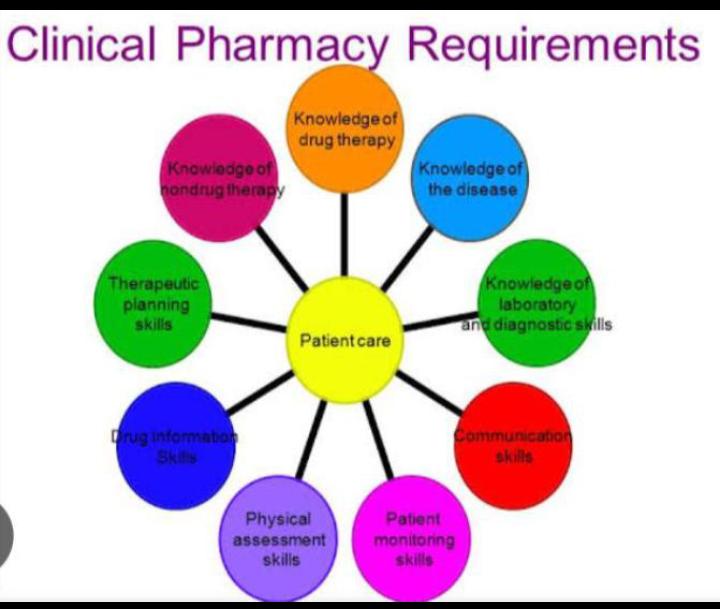
The under listed are basic and pertinent among so many other skills or requirements for Clinical Pharmacy Practice, and better healthcare for humanity, in collaboration with other healthcare professionals:
1) PATIENT ASSESSMENT SKILLS.
Clinical Pharmacists may sometimes need to perform basic physical assessments, including INSPECTION, PALPATION, PERCUSSION, and AUSCULTATION, to gather additional information about a patient’s condition.
They require strong patient assessment skills to optimize medication therapy and provide patient-centered care. These skills involve systematically collecting and analyzing patient health information to identify medication-related problems, assess patient needs, and develop appropriate interventions.
This includes evaluating medication appropriateness, monitoring for adverse effects, and collaborating with other healthcare professionals.
Clinical pharmacists are trained to gather subjective and objective data about a patient’s health, including physical assessments, medication histories, and identification of potential barriers to medication adherence.
2) KNOWLEDGE OF DRUG THERAPY.
Clinical pharmacists’ specialized knowledge of drug therapy is a valuable asset in healthcare, enabling them to improve medication use, enhance patient safety, and promote positive health outcomes.
Some clinical pharmacists have knowledge of how genetic variations can affect drug response and can use this information to personalize therapy.
Clinical pharmacists have a deep understanding of how drugs work at the molecular and cellular level, including their mechanisms of action and potential effects.
3) KNOWLEDGE OF NON DRUG THERAPY .
Clinical pharmacists are increasingly recognized for their expertise in non-drug therapies, particularly in lifestyle modifications and disease management.
They play a crucial role in patient education, counseling, and promoting adherence to recommended therapies beyond medications.
This includes areas like diet, exercise, self-monitoring, and other behavioral changes that can significantly impact health outcomes.
4) KNOWLEDGE OF DISEASE CONDITIONS .
Clinical Pharmacists are trained to possess a deep understanding of disease conditions, focusing on how medications affect these conditions.
They play a vital role in managing conditions like diabetes, hypertension, asthma, and heart disease.
Infectious Diseases etc:
They provide guidance on antimicrobial stewardship, infection prevention, and the appropriate use of antibiotics.
5) THERAPEUTIC PLANNING SKILLS .
Clinical pharmacists collaborate with patients and other healthcare professionals to establish clear, measurable, achievable, relevant, and time-bound (SMART) therapeutic goals.
6) KNOWLEDGE OF LABORATORY AND DIAGNOSTIC/ INTERPRETATION SKILLS
Clinical pharmacists who have strong foundation in laboratory and diagnostic skills are better equipped to provide comprehensive and effective medication management, contributing to improved patient outcomes.
According to a study published on SciSpace, pharmacists recognize the importance of these skills for modern clinical pharmacy practice.
Pharmacists utilize both analytical and non-analytical approaches to diagnose and solve medication-related problems, with probabilistic reasoning being a key component in improving accuracy and reducing unnecessary testing.
They are able to analyze and interpret laboratory data, recognizing normal and abnormal findings, and understanding the implications for patient care.
This knowledge is crucial for pharmacists to assess a patient’s condition, monitor treatment effectiveness, identify potential drug interactions or adverse effects, and make informed decisions about medication therapy.
7) DRUG INFORMATION ( DI ) SKILLS
Clinical pharmacists rely heavily on drug information (DI) skills to provide safe and effective medication-related care. These skills encompass the ability to retrieve, evaluate, and apply drug information from various sources to address clinical questions and dilemmas. This includes a systematic approach to answering DI queries, utilizing analytical thinking, communication, and attention to detail.
8 ) COMMUNICATION SKILLS
Clinical pharmacists acquire strong communication skills via training , to effectively interact with patients, healthcare professionals, and other stakeholders. This includes the ability to clearly convey complex information about medications, understand patient needs, and build trusting relationships.
9) PATIENT MONITORING SKILLS.
Clinical pharmacists possess crucial patient monitoring skills, encompassing the ability to assess patient health, interpret diagnostic reports, and monitor medication effectiveness.
They play a vital role in identifying and resolving potential medication-related problems, optimizing drug therapy, and ensuring patient safety.
COURTESY :
African Society of Clinical Pharmacists (ASOCLIP).
Join ASOCLIP today to help advance HUMAN HEALTH and Clinical Pharmacy In African Countries & beyond.
To join ASOCLIP, kindly chat up :
+227 90 96 53 39,
+234 803 723 3500,
+256 779 816896, or
+234 803 3367881.
( WhatsApp Chats Only )