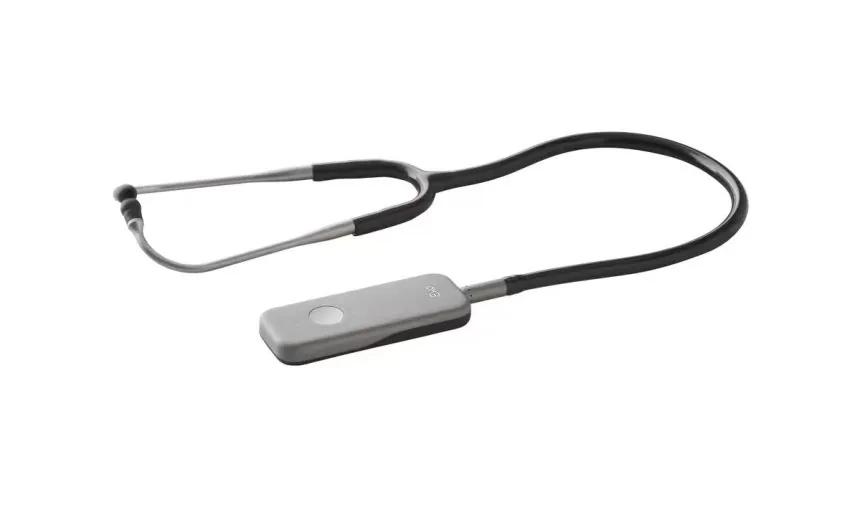
British doctors and researchers have successfully developed an artificial intelligence-based stethoscope that can detect three heart conditions – heart failure, heart valve disease, and abnormal heart rhythms – in seconds.
The stethoscope, invented in 1816, is a vital part of a doctor’s toolkit, used to listen to sounds within the body.
The AI stethoscopes work by analysing subtle differences in heartbeats and blood flow that human ears cannot detect, while simultaneously performing a rapid test to record the electrical activity in the heart.
Early diagnosis is vital for all three conditions, allowing patients who may need potentially lifesaving medicines to be identified sooner, before they become dangerously unwell.
The stethoscopes function by placing a playing card-sized monitor onto the patient’s chest, which takes an electrocardiogram (ECG) to measure the electrical signals from the heart and uses a microphone to record the sound of blood flowing through it.
Both sets of data are then sent to the cloud and analysed using AI that has been trained on similar information from tens of thousands of patients.
The pilot, conducted by Imperial College London and Imperial College Healthcare NHS Trust, involved more than 200 GP surgeries with over 1.5 million patients. It focused on people with symptoms such as breathlessness, fatigue, or swelling in the lower legs or feet, which are all indicators of heart failure.
Scientists, in a presentation at the European Society of Cardiology’s annual congress in Madrid, said that those examined with the device were 2.33 times more likely to receive a heart failure diagnosis within the following 12 months compared to those who did not.
In addition, the stethoscope proved 3.45 times more effective at identifying cases of atrial fibrillation and 1.92 times better at diagnosing heart valve disease.
Dr Sonya Babu-Narayan, clinical director at the British Heart Foundation and consultant cardiologist, commented that this is an elegant example of how the humble stethoscope, invented more than 200 years ago, can be upgraded for the 21st century.
Babu-Narayan added, “We need innovations like these, because so often this condition is only diagnosed at an advanced stage when patients attend the hospital as an emergency.”
The tool could be a “real game-changer”, enabling patients to be treated sooner, and there are plans to introduce the new stethoscopes to GP practices in south London, Sussex, and Wales.